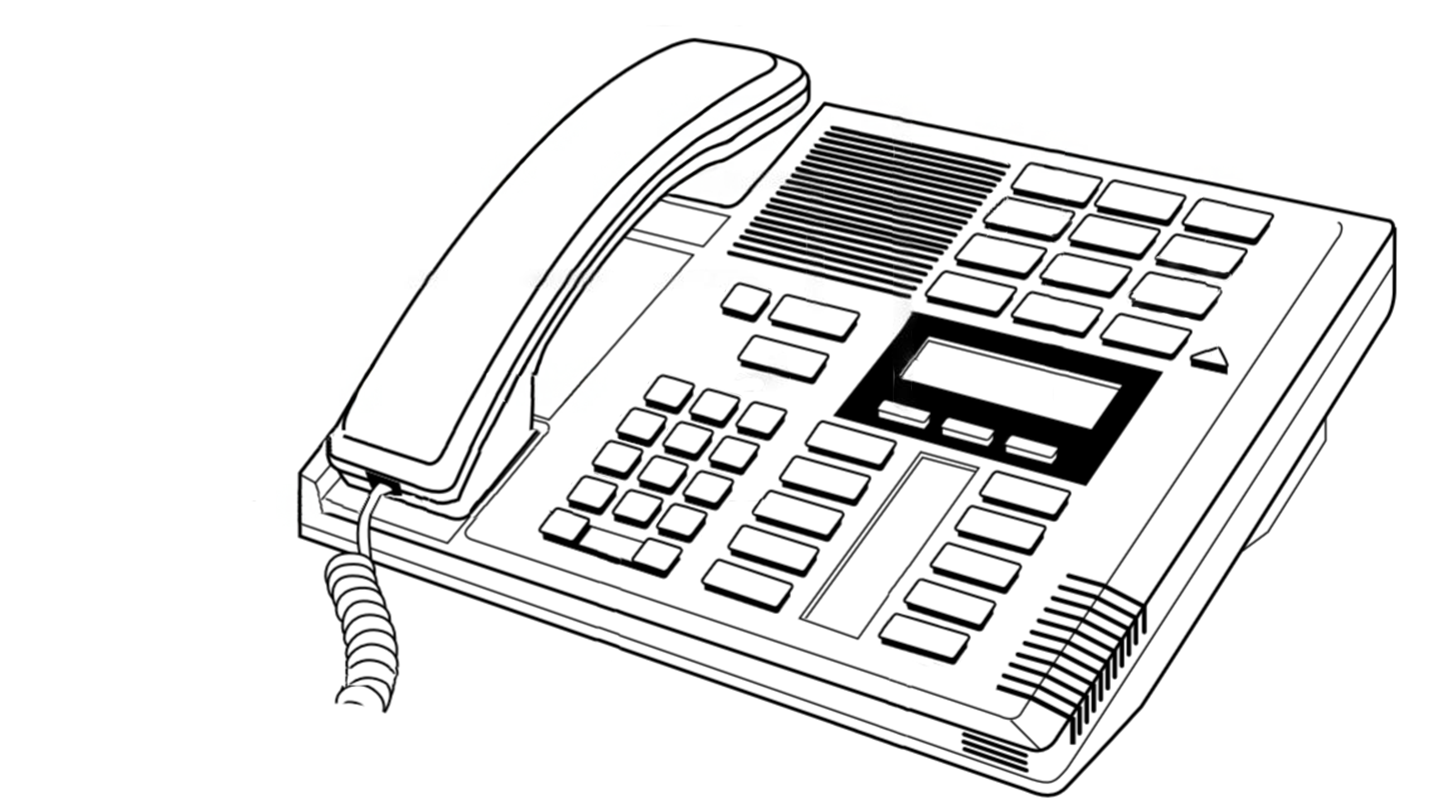
Northern Telecom product illustration
|
|
M7310
M-Series · 20-Button Digital Set
The M7310 is the mid-to-high model of the Norstar M-Series family and the set most
commonly designated as the System Coordinator telephone. Its distinguishing feature
is the 2-line alphanumeric display paired with three display navigation keys
directly below it — a context-sensitive interface that guides the user through
system programming menus step by step without requiring a separate terminal or
printed command reference. With 10 programmable line/feature buttons and
10 dual-LED indicator buttons, the M7310 also serves as an effective receptionist
and multi-line attendant set.
| › |
10 programmable line/feature buttons + 10 dual-LED indicator buttons |
| › |
2-line, 16-character alphanumeric display |
| › |
3 display navigation keys — context-sensitive programming interface |
| › |
Preferred set for System Coordinator and receptionist positions |
| › |
Available in Charcoal and Almond |
| › |
KSU loop-powered — no external power supply |
|
| Model Number |
M7310 |
| Series |
Norstar M-Series |
| Programmable Buttons |
10 line/feature buttons — configurable as line appearances, intercom keys, speed dial, or feature access |
| Indicator Buttons |
10 dual-LED buttons for monitoring extension and line state (busy/idle/ringing); also assignable as programmable keys |
| Display |
2-line × 16-character alphanumeric LCD |
| Display Navigation Keys |
3 context-sensitive keys positioned directly below the display; labels change dynamically to reflect available actions at each step of system programming and feature menus |
| Fixed Keys |
Release (red), Feature (red), Hold (red), Volume Up, Volume Down, dial pad (0–9, *, #) |
| Message Waiting |
LED indicator illuminated by KSU when voicemail or messages are waiting |
| Handset |
Standard NT digital handset with coiled cord |
| Speakerphone |
None — handset operation only |
| Headset Port |
Not present on standard M7310 |
| Ringer |
Adjustable volume and tone (programmable via Feature 1) |
| Station Connection |
Single pair, standard Norstar digital station port (RJ-11 / RJ-45 to 25-pair distribution) |
| Power |
Loop-powered from KSU over station pair — no local AC adapter required |
| Max. Station Cable Run |
Up to 300 m (1,000 ft) on 24 AWG solid copper — see Wiring Reference for full distance table |
| Colour Options |
Charcoal (standard), Almond |
| Desk Stand |
Integrated tilt stand, two positions |
| Wall Mountable |
Yes — handset retainer clip reversible for wall-mount orientation |
| Add-on Modules |
Not supported — see M7324 for CAP / DSS module capability |
| KSU Compatibility |
Norstar 3x8, 6x16, Compact ICS (all versions), Integrated ICS, Modular ICS |
| Interoperability |
Fully interchangeable on same system with M7100, M7208, M7324, T7100, T7208, T7316, T7316e, T7406 |
| Approx. Dimensions |
230 mm × 222 mm × 88 mm (W × D × H with stand) |
| Approx. Weight |
Approx. 1.1 kg |
| Key and Button Reference |
|
| Key / Button |
Type |
Function |
| Buttons 1–10 |
Programmable |
Assignable as: line appearance, intercom (DN) key, speed dial, feature code shortcut, or Answer DN. Each has a dual-LED indicator (red/green) showing line and call state. Default assignment configured by the System Coordinator during installation. |
| Indicator Buttons 1–10 |
Programmable / Monitor |
Dual-LED buttons that provide at-a-glance status for assigned extensions or lines. The LED shows idle (off), busy (steady red), or ringing (flashing). Commonly assigned as Answer DN keys by receptionists and attendants for one-touch pickup of calls at monitored extensions. |
| Display |
LCD |
2-line × 16-character alphanumeric. Line 1 typically shows caller/line identification, extension name, or current programming prompt. Line 2 shows call duration, feature status, or the available action labels corresponding to the three display navigation keys below. |
| Display Nav Keys 1–3 |
Context-sensitive |
Three unlabelled keys positioned immediately below the display. Their function changes at every step — the bottom line of the display shows the current label for each key. During system programming, these keys are used to navigate menus, scroll through option lists, confirm selections, and move between programming headings without entering feature codes. Outside of programming, they may show caller information navigation or feature shortcuts depending on system configuration. |
| RLS (Release) |
Fixed — red |
Ends the active call and releases the line. Also used to exit from feature programming menus without saving. Equivalent to replacing the handset. |
| Feature |
Fixed — red |
Activates feature code entry mode. Press Feature followed by the feature code number (e.g., Feature 70 for Do Not Disturb). On the M7310, pressing Feature ** followed by the System Coordinator password enters the full programming tree, navigable via the display navigation keys. |
| Hold |
Fixed — red |
Places the active call on exclusive hold at this set. The held line button flashes to indicate a held call. For system hold (retrievable by any set), use Feature 83. |
| Volume ▲ |
Fixed |
Increases handset receive volume during a call. Outside of a call, increases ringer volume. Settings are retained after the call ends. |
| Volume ▼ |
Fixed |
Decreases handset receive volume during a call. Outside of a call, decreases ringer volume. |
| Dial Pad |
Fixed |
Standard 12-key touchtone pad (0–9, *, #). Used for dialling, entering feature codes, entering data values during programming (e.g., passwords, timer values, extension numbers), and alphanumeric name entry via multi-tap. |
| MSG Indicator |
LED |
Steady red light indicates a message waiting — typically illuminated by the voicemail system (CallPilot, Flash, etc.) when a new message is present in the mailbox associated with this extension. Press Feature 65 to access messages. |
| |
Using the display navigation keys for system programming:
With the M7310 on-hook, press Feature ** and enter the System Coordinator
password. The display immediately shows the first programming heading on line 1,
with the three navigation key labels on line 2 — typically
Show, Next, and Chng (or similar).
Use the left and right navigation keys to move between headings, the centre key
to step into a sub-menu or change a value, and RLS to back out or exit
without saving. No separate administration terminal or laptop is required.
Refer to the System Coordinator Guide
for the full programming tree.
|
| Programmable Button Types |
|
| Assignment Type |
Description |
| Intercom (DN) Key |
Represents the set’s own extension. Used to place and receive internal calls and to originate external calls. At least one intercom key is required per set. |
| Line Appearance |
Direct access to an external trunk line. Pressing the button seizes that line; the LED shows real-time line state (idle, in use, ringing, on hold). |
| Answer DN |
Monitors another extension and allows pickup of calls ringing at that DN. The LED flashes when the monitored extension is ringing. The primary use of indicator buttons on the M7310 — enables the receptionist to see and answer calls for multiple extensions from a single set. |
| Speed Dial |
One-touch dialling of a stored number. Can be a personal speed dial (user-programmed) or a system speed dial (set by the System Coordinator). |
| Feature Key |
Stores a feature code sequence for single-key activation of a frequently used feature (e.g., Do Not Disturb, Call Forward, or Last Number Redial). |
| Handsfree Answerback |
Enables the set to auto-answer internal voice-announced calls through the handset. Configured by the System Coordinator per set. |
Button assignments are set during system programming using the System Coordinator menu
(Feature ** System Coordinator password). Refer to the
System Coordinator Manual
or the M7310 User Card for button labelling
and programming procedures. A blank button label card is located under the transparent overlay on the set.
Photographs of the M7310 in charcoal and almond finish, display navigation key and button panel detail, and typical coordinator installation.
[ Photograph — Front View ]
M7310 Charcoal — front
three-quarter view
|
|
Front view — charcoal finish
|
[ Photograph — Front View ]
M7310 Almond — front
three-quarter view
|
|
Front view — almond finish
|
[ Photograph — Display Detail ]
2-line display and three
display navigation keys
close-up
|
|
Display and navigation key detail
|
[ Photograph — Button Panel ]
Programmable and indicator
button columns with label
card inserts
|
|
Button columns and label card detail
|
[ Photograph — Rear View ]
Rear panel showing line cord
socket, stand positions, and
wall-mount hook
|
|
Rear panel — connectors and stand
|
[ Photograph — In Situ ]
M7310 at a receptionist or
System Coordinator desk
installation
|
|
Typical coordinator/receptionist desk
|
| Documentation |
|
| Document |
Type |
Open |
| Norstar M7310 User Card |
User Card (NT original) |
Open PDF |
| Norstar M7310 Quick Reference Guide |
Quick Reference |
Open PDF |
| M7310 Telephone User Guide (Avaya edition) |
User Guide |
Open PDF |
| CICS 7.0 System Coordinator Guide |
System Coordinator |
Open PDF |
| Norstar Feature Code Quick Reference |
Reference Page |
Open Page |
| |
Related M-Series Telephone Sets:
M7100 — single-line, 1-line display ·
M7208 — 8 buttons, 1-line display ·
M7310 — 10+10 buttons, 2-line display, display nav keys ·
M7324 — 24 buttons, 2-line display, CAP-capable
|
|
|